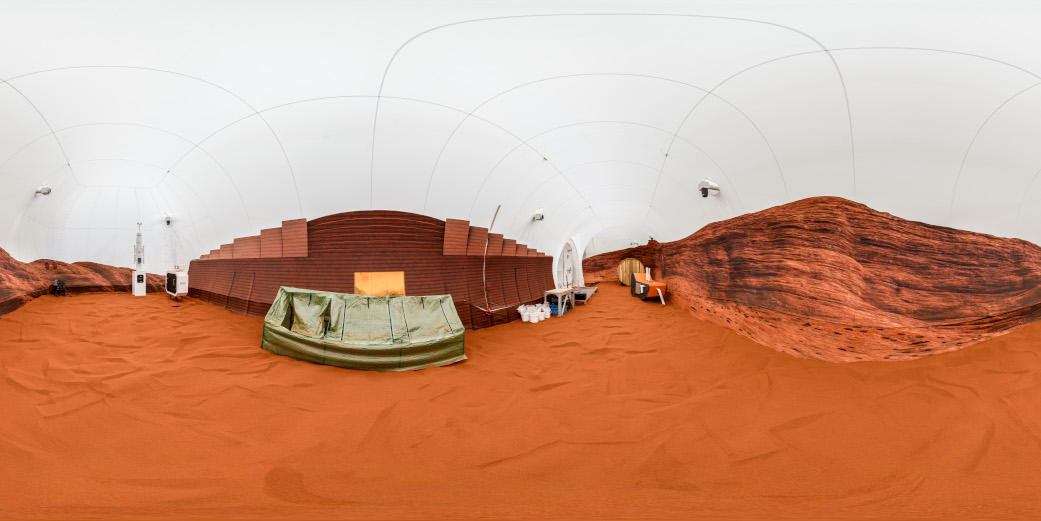
Four volunteers who have not stepped outside in more than a year will walk out of a simulated Mars habitat at Johnson Space Center on Saturday, Oct. 31, ending a 378-day isolation experiment in NASA's backyard.
The exit ceremony for the Crew Health and Performance Exploration Analog (CHAPEA) Mission 2 begins at 2 p.m. Central time, according to a NASA media invitation published Tuesday, Oct. 27. NASA will stream the event live on NASA Johnson's YouTube channel and social media accounts.
JSC Director Vanessa Wyche and NASA astronaut Jack Hathaway will speak at the ceremony. The four crew members will also give remarks.
Who's inside
Commander Ross Elder, medical officer Ellen Ellis, science officer Matthew Montgomery and flight engineer James Spicer entered the 1,700-square-foot, 3D-printed habitat on Oct. 19, 2025. They have lived under conditions meant to mirror a Mars mission: communication delays of up to 22 minutes each way, limited resources, simulated spacewalks on a red-sand surface and equipment failures.
Their only contact with family has been email sent with a Mars-like delay. After exiting, the crew will reconnect with loved ones and then begin two weeks of post-mission evaluations and debriefs with NASA scientists, according to a separate NASA update published Oct. 19.
What they learned
The mission's primary purpose is human research, not a technology demonstration. NASA said health and performance data collected during the simulation can help the agency prepare for future Artemis and Moon Base missions by improving food system design, crew scheduling, medical care and behavioral support.
In an audio log recorded Oct. 1 for NASA's "Houston We Have a Podcast," crew members described daily surprises. Elder said the habitat is "eerily quiet," with mostly white noise from fans and equipment. He said he misses the sound of weather and busy streets so much that crewmates constantly see him with an earbud in, listening to music or recordings to fill the silence.
Spicer described using wrenches, drills and a drain snake on a near-daily basis. He said he once had to sew up a large hole in his flight suit with a needle and thread.
Ellis said the crew routinely performs self blood draws, a skill they learned in a short phlebotomy course before entering the habitat.
Asked what they looked forward to after the mission, Ellis said she wanted to see her husband smile when the egress door opens and hug her parents. Spicer, who described himself as a fan of swimming and the ocean, said he was most excited to take a long hot shower. All showers inside the habitat are timed because water is treated as a scarce resource.
How to watch
NASA will stream the ceremony on NASA Johnson's YouTube channel starting at 2 p.m. CDT (3 p.m. EDT) on Saturday, Oct. 31. The first CHAPEA mission concluded on July 6, 2024, in the same habitat.
Media seeking in-person access at JSC must contact the NASA Johnson newsroom by 2 p.m. Friday, Oct. 30.