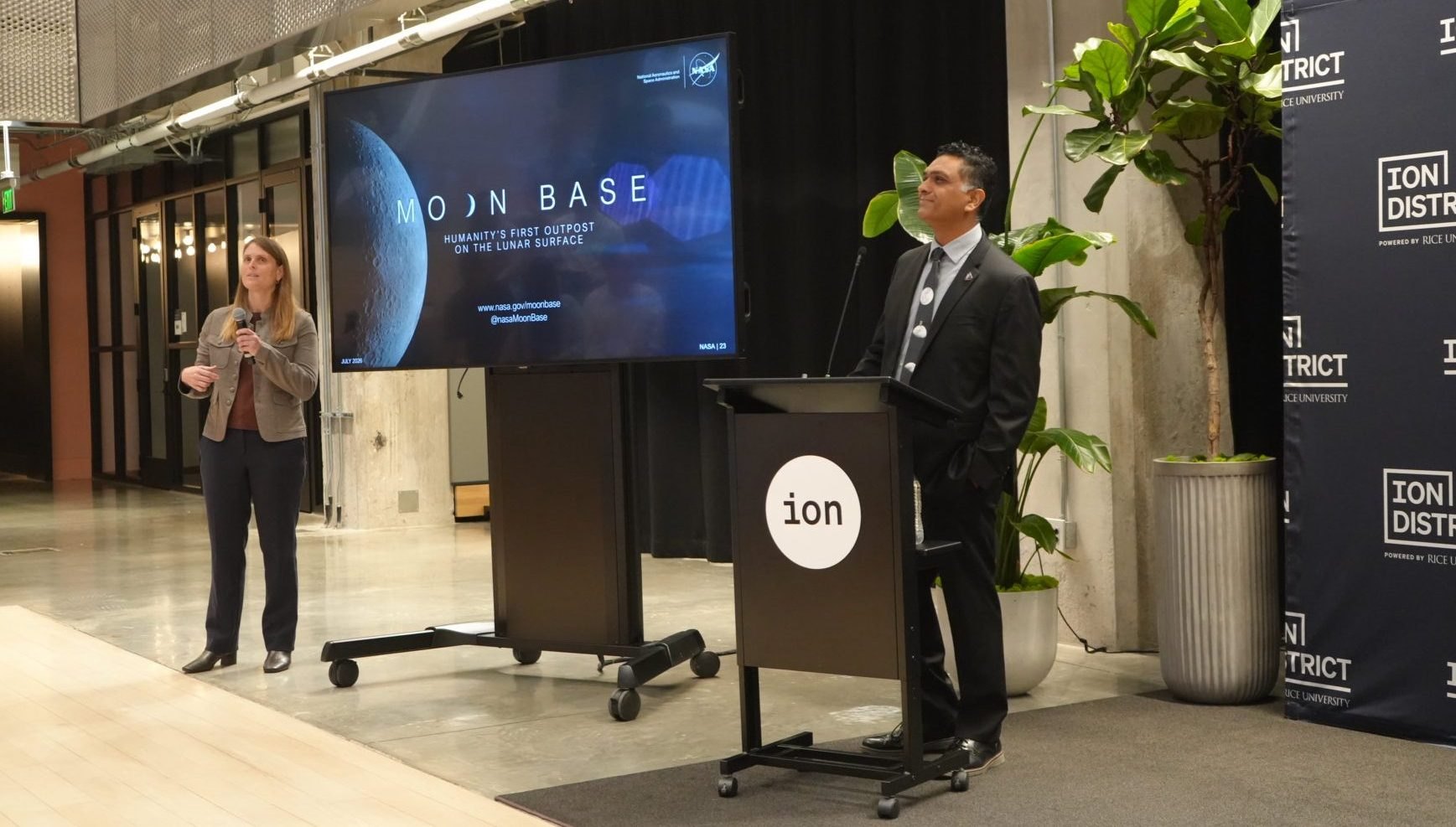
Building a permanent outpost on the Moon's South Pole is "probably going to be the most challenging endeavor NASA has ever undertaken," Johnson Space Center engineer Shatel Bhakta told a Houston audience on July 30.
Bhakta, principal systems engineer for NASA's Moon Base Program, laid out the obstacles during a NASA Stories at the Ion talk co-hosted by JSC, Rice University and the Ion District. The recurring series connects agency experts with entrepreneurs, researchers, students and industry leaders in Houston's innovation corridor.
Laura Neder, head of platform for the Rice Alliance for Technology and Entrepreneurship and the Ion District, welcomed the crowd. Monte Goforth, acting director of Business Development and Technology Integration at Johnson, introduced Bhakta.
Steep slopes, shifting shadows and killer dust
The lunar South Pole looks nothing like the flat plains where Apollo crews landed. Bhakta described steep slopes, deep craters and a Sun that barely rises above the horizon, casting shadows that shift throughout the year. Solar panels can lose sunlight for long stretches, forcing engineers to plan for heavy energy storage or alternative power sources.
The terrain also blocks line-of-sight communication with Earth, meaning NASA will need relay infrastructure so crews and rovers can stay connected.
Moon Base may not even be one place. Bhakta explained that terrain, lighting, power and landing constraints could force habitats and systems to be scattered across the surface rather than clustered together.
Then there's the dust. Lunar regolith is sharp, electrostatically charged and clings to everything. Without mitigation, it can shred spacesuits, foul equipment and threaten astronaut health. Its behavior changes with lighting and environmental conditions, making it unpredictable.
Water ice and a path to Mars
Some permanently shadowed craters near the South Pole may hold water ice that hasn't seen sunlight in billions of years. Tapping those resources could support long-term exploration, but doing so will demand new mobility, power and processing technology.
NASA views the Moon Base as a proving ground for Mars, a place to learn how crews and equipment perform far from Earth before attempting the longer journey.
Open doors for non-engineers
Bhakta made clear the effort needs more than rocket scientists. Communicators, business professionals and researchers all have a role.
"There are many ways to contribute," he said. "Don't be afraid that your skill set does not fit in."
Multiple industry solicitations for Moon Base participation are open, covering everything from early technology demonstrations to long-term surface operations. Details are available at nasa.gov/moonbase-solicitations.
What's next
The next NASA-related community talk at the Ion is NASA Tech Talks on Thursday, Aug. 27, featuring Rice University's Space Humanities Initiative.