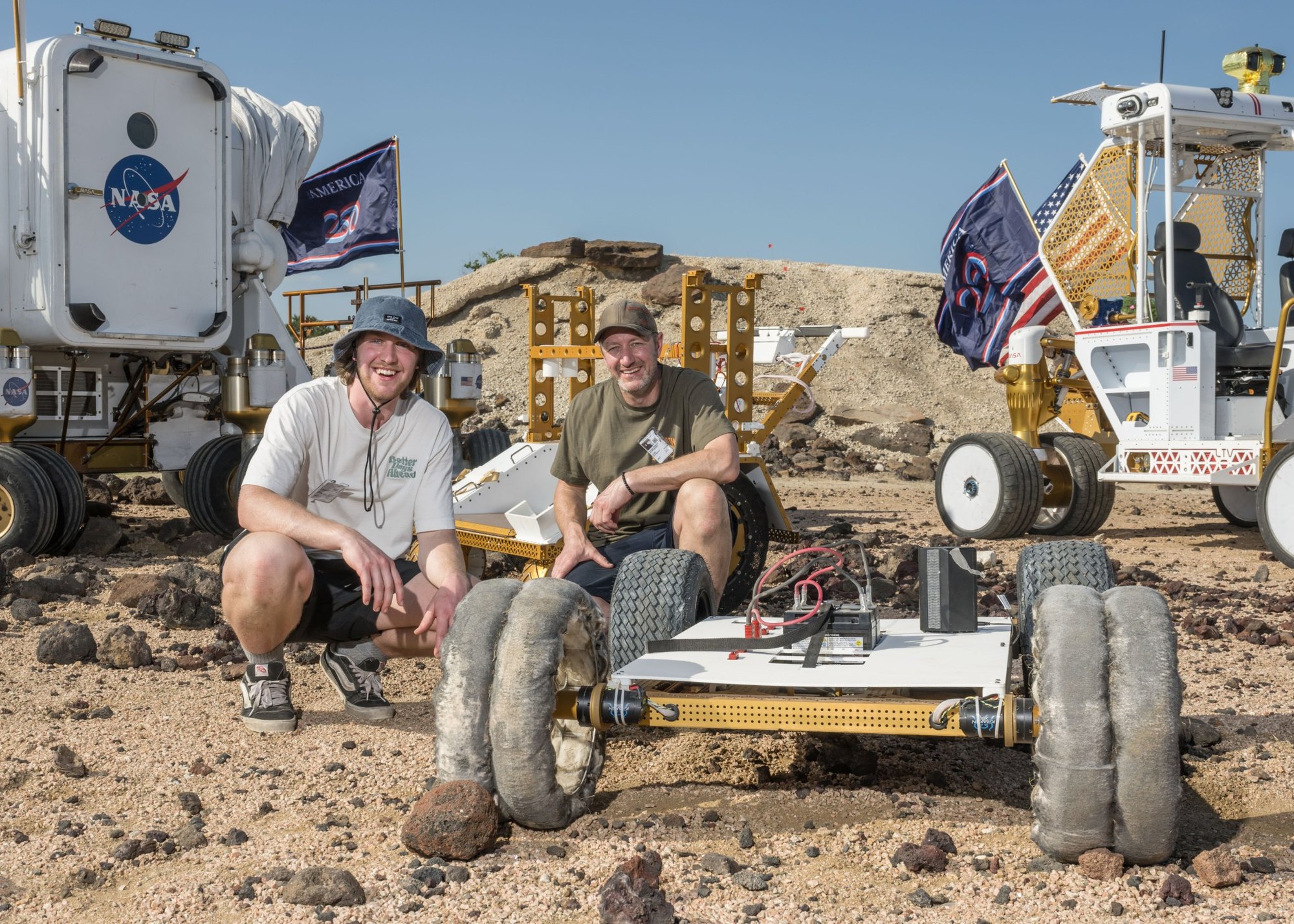
An Australian mechanical engineer and his son beat out 128 entries from 49 countries to win a NASA lunar rover wheel competition tested at Johnson Space Center's Rock Yard on July 31.
Daniel Bloomfield and his son Isaac Bloomfield took the top prize in the Rock and Roll with NASA Challenge with their Scotch Pad Tyres design, a Nomex-fabric tire wrapped around an aluminum hub. The soft material deforms around rocky terrain while internal supports keep the wheel's shape intact. An outer coating of epoxy and corundum grit gives it grip.
It beat four other finalists.
The $155,000 competition asked inventors worldwide to design wheels tough enough for long-duration lunar surface operations, according to NASA's challenge page. Five finalist teams mounted their prototypes to MicroChariot, a 45-kilogram test rover, and drove them through courses at JSC's Rock Yard to evaluate performance across different terrain.
"Every additional kilometer a rover can reliably travel will expand how far we can explore, what science we can achieve, and what infrastructure we can build," Ed Herrera, a JSC robotics engineer who co-led the challenge, said in a NASA press release Aug. 17.
Herrera and fellow JSC robotics engineer Lucien Junkin ran the competition through the Common Robotics Project within JSC's Engineering Directorate. HeroX administered the challenge on NASA's behalf, and engineers from NASA's Glenn Research Center in Cleveland reviewed concepts and proposals. Students in NASA's Robotics Academy helped prepare hardware on-site.
The four other finalists included a variable-stiffness wheel from Greek firm Hellenic Technology of Robotics SA, a tensioned-cable design from a team called Hyperbola, a titanium sheet-metal wheel from Huff Helo Inc. and a pneumatic design by aircraft mechanic Craige Payne and Deborah Payne that drew on early automobile tire concepts.
The competition is the latest use of JSC's Rock Yard and other on-site facilities to prove mobility technologies before lunar terrain vehicles reach the surface through the Commercial Lunar Payload Services initiative. NASA Artemis said on X that surface mobility will be key to moving crew around the lunar surface as the agency prepares to establish Moon Base.
Next, engineers could put the winning and finalist wheels through dust, vacuum and extreme-temperature testing inside JSC's thermal vacuum chambers. Longer-distance runs and tests at different sizes and loads are also under consideration, though NASA has not announced a timeline.