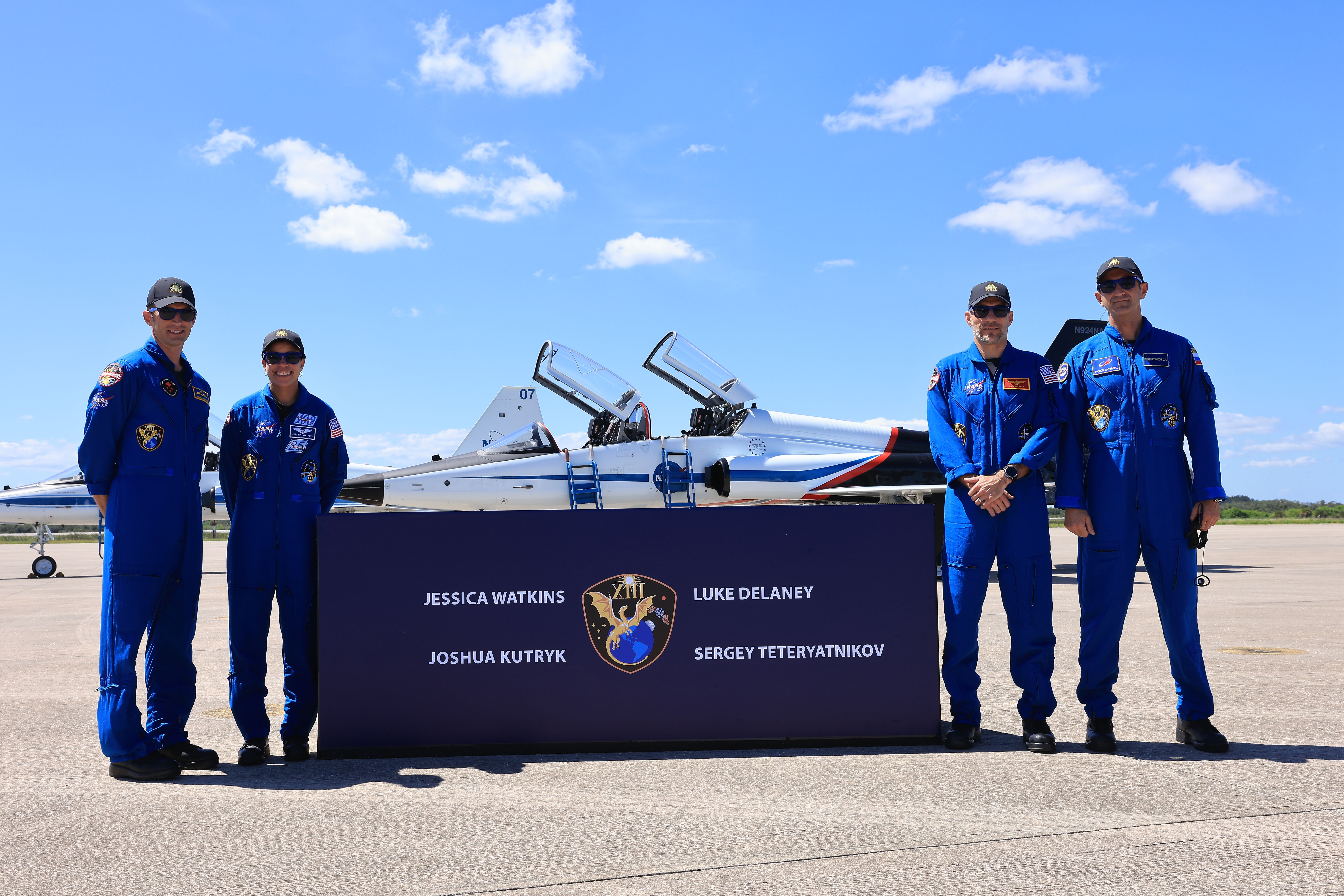
Four astronauts bound for the International Space Station left Houston on Saturday, Sept. 26, flying T-38 jets out of Ellington Field near Johnson Space Center.
NASA's SpaceX Crew-13 touched down at Kennedy Space Center in Florida at 12:56 p.m. EDT after a brief refueling stop in Mississippi, NASA confirmed. The crew will continue quarantine and complete prelaunch preparations at the Astronaut Crew Quarters inside Kennedy's Neil A. Armstrong Operations and Checkout Building.
Launch is set for 11:10 a.m. EDT Thursday, Oct. 1, aboard a SpaceX Falcon 9 rocket from Space Launch Complex 40 at Cape Canaveral Space Force Station.
Who's on board
The crew includes NASA astronauts Jessica Watkins, the mission commander, and Luke Delaney, the pilot. Canadian Space Agency (CSA) astronaut Joshua Kutryk and Roscosmos cosmonaut Sergey Teteryatnikov serve as mission specialists.
Watkins is the only veteran flier. She flew on NASA's SpaceX Crew-4 mission in 2022, spending 170 days in space. She will become the first NASA astronaut to launch aboard a SpaceX Dragon spacecraft twice, according to a NASA briefing. Delaney, Kutryk and Teteryatnikov are all making their first trip to orbit.
Delaney, a former Marine Corps naval aviator who served 22 years before retiring in 2020, said the reality of his first spaceflight was sinking in. "I think that's when it starts to hit. We've completed all our benchmarks and we're finishing up the last bit of training here before we go into quarantine," he told CW39 Houston in an Aug. 6 interview at Johnson Space Center.
Kutryk, from Fort Saskatchewan, Alberta, served as a CF-18 fighter pilot and experimental test pilot before the CSA selected him as an astronaut in 2017. Teteryatnikov graduated from the Naval Academy in St. Petersburg, Russia, in 2011 and was selected for the Roscosmos cosmonaut corps in 2021.
Green light from review
NASA, SpaceX and international partners polled "go" on Friday, Sept. 25, following a Flight Readiness Review at Kennedy Space Center. The review assessed SpaceX's transportation system, mission operations and readiness of the station to receive the incoming crew.
Crew-13 is SpaceX's 13th crew rotation mission for NASA and its 14th flight carrying NASA astronauts to the station, including the Demo-2 test flight.
Science on the schedule
Once aboard the station, the crew will support several biomedical investigations, NASA said. Among them is Venous Haemostasis, a NASA-European Space Agency collaboration studying how spaceflight affects blood flow and clotting. Jason Lytle, a cardiovascular researcher at Johnson Space Center, said the study will help scientists understand why some astronauts develop blood-flow changes in space while others do not.
The crew will also run lunar-landing simulations for a Manual Piloting study and test whether B-vitamin supplements can reduce Spaceflight-Associated Neuro-ocular Syndrome (SANS), a vision condition linked to long-duration spaceflight.
NASA's Johnson Space Center said on X that the crew walked to their T-38s in blue flight suits, carrying green bags. One of the two jets bore a paint scheme reflecting the Artemis program.
What's ahead
- Thursday, Oct. 1: Crew-13 launch, 11:10 a.m. EDT, Cape Canaveral Space Force Station.
The crew won't return to Houston until next year.